
The 1906 earthquake struck at 5:12 a.m. on April 18, and fire did the rest. The National Park Service's account has the Army preparing a firebreak along Van Ness Avenue and its mansions on the evening of April 19, with three blocks of houses brought down every twenty minutes. California law keeps a fire that is caused by or follows an earthquake on the fire policy (Insurance Code section 10088.5), so here the home policy's dwelling limit carries the fire and the earthquake policy carries the shaking.
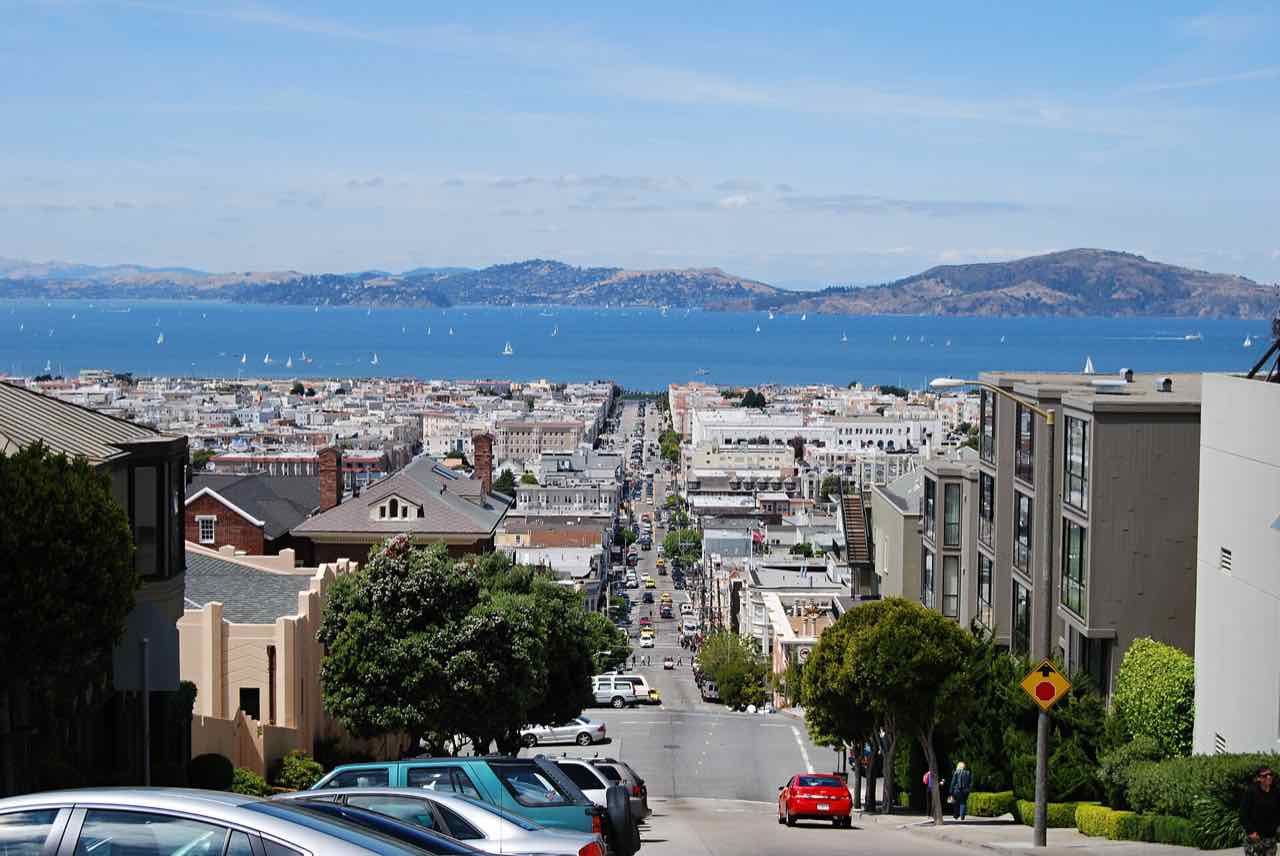

Ridge, flat and bluff on the state hazard map
- Loma Prieta, 1989The U.S. Geological Survey puts it at 5:04 p.m. on October 17, 1989, magnitude 6.9, with the epicenter about 60 miles southeast of San Francisco. Liquefaction caused severe damage to buildings in the Marina district.
- The flatOn the California Geological Survey's seismic hazard zone map for San Francisco, released November 17, 2000, points I checked on Marina Boulevard and at Union and Fillmore streets in Cow Hollow fall inside a liquefaction zone.
- The ridgePoints I checked at Broadway and Divisadero in Pacific Heights and at Washington and Spruce in Presidio Heights fall in neither a liquefaction zone nor a landslide zone.
- The bluffA point I checked on Sea Cliff Avenue above the beach falls inside an earthquake-induced landslide zone.
- Building near itThe Department of Building Inspection's Information Sheet S-05, dated November 4, 2025, says third-party engineering review may be required for a new building over 1,000 square feet, additions that create 1,000 square feet, or more than 50 cubic yards of excavation or fill, when the lot lies in or touches that landslide area. The department says the older Slope and Seismic Hazard Zone Protection Act, which tied review to slope alone, has been eliminated.
Each of those is one point, not your lot. The natural hazard disclosure from your purchase, or the state's online zone map, answers it for the parcel, and underwriters ask.
Soft-story and brick: which rules reach a house
San Francisco's mandatory soft-story program, Ordinance 66-13, covers wood-frame buildings of three or more stories, or two over a basement, that hold five or more dwelling units and whose construction permit was applied for before 1978. The state's unreinforced masonry law, Government Code section 8875, defines a potentially hazardous building so as to leave out any building with five living units or less. A single-family house falls outside both definitions, even with brick walls, a brick foundation or tall masonry chimneys, and so does a mansion divided into a few flats. I have found no San Francisco program that requires a single-family house to be seismically strengthened, so there is no city certificate to show an insurer. The underwriter asks instead about the foundation, bolting and bracing, the chimneys, and any engineer's report or retrofit permit, and I send those with the application. For the buildings the ordinance does reach, see earthquake insurance in San Francisco.
What the CEA form leaves out of a period house
- Who can buy itOnly owners whose home insurer participates in the California Earthquake Authority, and the CEA dwelling limit has to equal the home policy's.
- ChimneysTen thousand dollars in total for all chimneys attached to the house, however many there are.
- Plaster and veneerPlaster is paid only up to the cost of replacing it with drywall. Exterior masonry veneer is excluded; stucco is not counted as veneer.
- Decorative featuresDecorative or artistic features, among them stained or leaded glass, murals, chandeliers, mosaics and carvings, are not covered. Where one serves a practical purpose, the form pays no more than a plain functional replacement.
- Code upgradesTen thousand dollars is included, and twenty or thirty thousand can be bought.
- Contents and living costsArtwork is listed as personal property not covered, and loss of use tops out at one hundred thousand dollars.
On a house where plaster, glass and millwork are much of the rebuild, those lines decide the claim. I price private earthquake policies beside the CEA and compare the forms line by line. Earthquake insurance in California.
What the City lets you put back
Planning Code section 188(b) lets a noncomplying structure that is damaged or destroyed by fire or other calamity be restored to its former condition, if the Building Code permits it and the work is started within eighteen months, which the section defines as filing the building permit application within that time. A structure that is voluntarily razed has to come back in full conformity with today's code. The Planning Department's own example of a noncomplying structure is a building that legally sits within a now-required setback. Whether your house is one is a question to settle with the department before a loss, not after.
For a designated City landmark or a house in an Article 10 historic district, a Certificate of Appropriateness is the approval required for exterior alterations that need a permit and for demolition. The department's bulletin says none is needed for interior alterations, or for ordinary maintenance and repairs, which it defines to include repairing damage from fire or other disaster with materials and details replaced in kind. Repair in kind means period materials and the trades that work them, so I build the dwelling limit from this house's construction, not from a generic figure per square foot.
California's required residential disclosure describes building code upgrade coverage, also called ordinance and law, as paying the added cost of meeting the building codes and zoning laws in effect when you rebuild. On the home policy I set that limit on its own line. Ordinance or law coverage and extended versus full replacement cost.
Where a large San Francisco house gets placed
When a standard insurer will not take an older house at this value, the placement goes to an admitted high-value insurer or to surplus lines. Insurance Code section 1763 allows a surplus lines placement only when admitted insurers that actually write the cover will not provide it, makes the broker responsible for a diligent search among them, and bars it as a way to get a lower rate. Behind both stands the California FAIR Plan, with a residential limit the Department of Insurance lists as three million dollars per location on a limited fire policy; a house with a rebuild cost above that outgrows it. A non-renewal notice is due at least 75 days before expiration under section 678.
Flood is a separate policy. By statute the National Flood Insurance Program insures a one-to-four-family building up to two hundred fifty thousand dollars and its contents up to one hundred thousand. Its dwelling form pays no more than twenty-five hundred dollars per loss for artwork, collectibles, rare books, jewelry and furs together, and lists retaining walls and seawalls as property not insured. For a house in a mapped flood zone I quote excess flood above it.
Renovations, staff, collections and title
A long renovation is its own exposure. California's standard fire policy, Insurance Code section 2071, suspends cover while a building is vacant or unoccupied beyond 60 consecutive days unless the policy says otherwise in writing, and a house emptied for a remodel can cross that line. I arrange course-of-construction cover or the insurer's written consent before work starts.
A housekeeper, nanny or house manager you employ is an employee for workers' comp under Labor Code section 3351(d), unless they worked under 52 hours or earned one hundred dollars or less in the 90 days before an injury (section 3352). Insurance Code section 11590 requires a personal liability policy to carry that cover unless another workers' comp policy applies. Workers' comp for household employees.
Art, jewelry and wine are scheduled at agreed values, since neither the federal flood form nor the CEA form does much for them: insuring jewelry, art and collectibles. If title is in a trust or an LLC, the named insured has to match it: homes owned by a trust or LLC. An umbrella sits over the home and cars.
Ways to start
- Have your current policy readUpload the declarations page and get a written second look in about a minute: what it covers, what to double-check and what it leaves out.
- Send everything at onceOwners, business managers and family offices: private client insurance puts every home, flood, earthquake, umbrella and valuables policy on one file.
- Buying, with a closing dateYour real estate agent can send me the address and the closing date, and the evidence of insurance goes to escrow and the lender.
- Check the address and the limitThe address hazard lookup shows the flood zone, wildfire hazard and nearby fires on the public maps, and the rebuild cost estimator checks the dwelling limit.
What I need to quote
The declarations pages for the home, earthquake, flood and umbrella policies; year built, square footage, stories and construction, including the foundation and chimneys; any engineer's report, retrofit permit or geotechnical report; the natural hazard disclosure from your purchase; whether the house is a City landmark or in a historic district; the latest rebuild estimate or appraisal; dates of the last electrical, plumbing and roof work; any renovation planned in the next year; household staff and hours; and a schedule of art, jewelry and wine with appraisal dates.
Common questions
Who insures large Victorian and Edwardian homes in Pacific Heights?
Admitted high-value insurers write some, and surplus lines insurers take others after the diligent search California requires. The age of the wiring, plumbing and roof, the foundation and the rebuild estimate decide which route a house takes.
Does CEA earthquake insurance cover plaster walls, leaded glass and chimneys in an old San Francisco house?
Only in part. The 2026 CEA homeowners form pays for plaster up to the cost of drywall, caps all chimneys together at ten thousand dollars, and excludes decorative features such as stained or leaded glass and exterior masonry veneer.
Is my Pacific Heights house in a liquefaction zone?
Points I checked on the ridge are not, while points in the Marina and in Cow Hollow below are, on the state's seismic hazard zone map released November 17, 2000. Your natural hazard disclosure or the state's online map answers it for your parcel.
Does San Francisco's soft-story retrofit law apply to my single-family house?
No. Ordinance 66-13 covers wood-frame buildings of three or more stories with five or more dwelling units, so a single-family house is outside it. Insurers ask about the foundation, bracing and chimneys instead.
Can I rebuild my San Francisco house the way it was after a fire?
Planning Code section 188(b) lets a noncomplying structure destroyed by fire or other calamity be restored to its former condition if the Building Code permits it and the permit application is filed within eighteen months. A structure that is voluntarily razed has to meet today's code.
If an earthquake starts a fire that burns my house, which policy pays?
The fire policy. Insurance Code section 10088.5 says an insurer stays obligated under a fire insurance policy for the losses of a fire that is caused by or follows an earthquake. Shaking damage itself needs an earthquake policy.
Do I need workers' comp for a nanny or housekeeper in San Francisco?
California treats household staff as employees once they pass 52 hours or one hundred dollars in wages in the 90 days before an injury, and Insurance Code section 11590 requires a personal liability policy to include that cover unless another workers' comp policy applies.
General information about high-value home insurance in Pacific Heights, Sea Cliff and Presidio Heights as of November 2026, not legal advice. Hazard zone results are for the single points described, read from the California Geological Survey's map data; your parcel may differ. Planning Code and Building Code provisions, Department of Building Inspection information sheets and the CEA policy form are summarized as they read in November 2026. Your policy wording controls what is covered. Coverage depends on underwriting and the terms, conditions and exclusions of the policy actually issued.