
The Minnesota FAIR Plan is no fallback for a house like this. Its posted underwriting guidelines exclude homeowner risks valued above the surplus lines threshold in Minnesota Statutes section 60A.201, cap coverage at the market value of the structures, and do not offer the homeowners form to seasonal property or to a house owned by an LLC or other business entity. So a large lake house is placed with an admitted high-value insurer or through a surplus lines broker. Flood is always a separate policy.
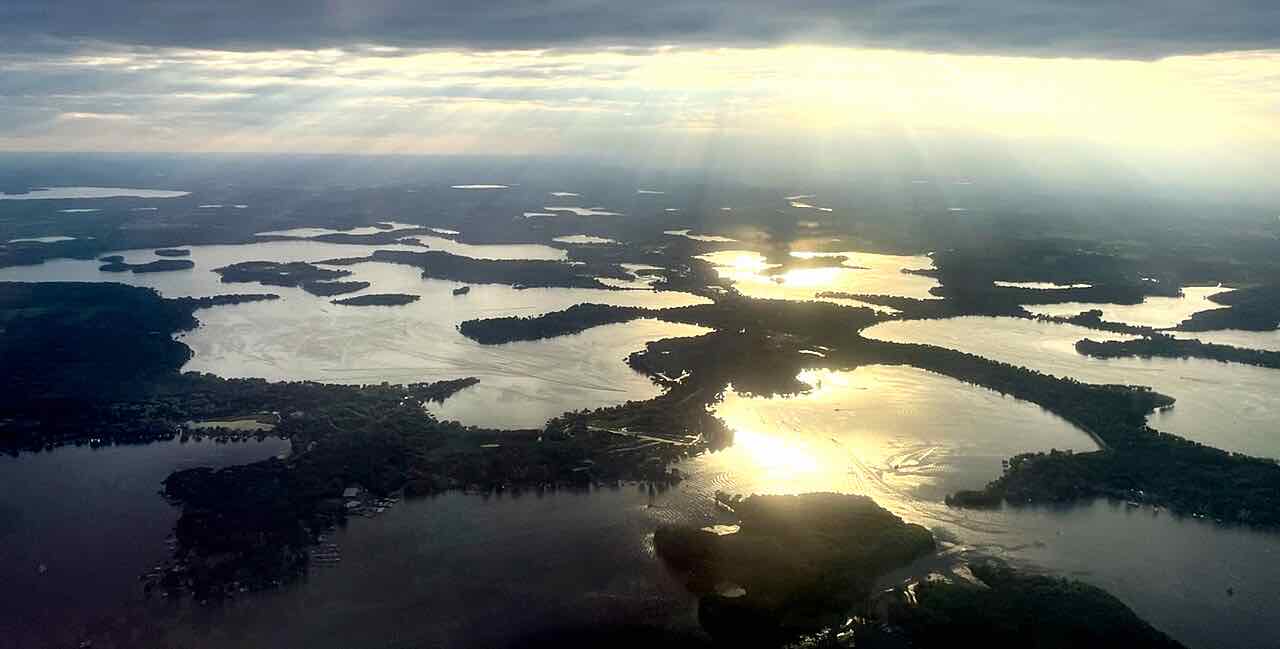

What the local record shows an underwriter
- June 23, 2014The Minnehaha Creek Watershed District's flood report puts Lake Minnetonka's record level at 931.11 feet against an ordinary high water level of 929.4, counts 119 days above that level in 2014, and records a lake-wide minimum wake restriction from June 5 to July 24.
- August 9 and 10, 2020The State Climatology Office describes supercells with cores of ping pong ball to tennis ball-sized hail from Wright County to Loretto, Maple Plain and Edina in Hennepin County.
- July 28, 2025The National Weather Service office in Chanhassen logged gusts of 60 to 70 miles an hour across the Twin Cities metro, with a fire department report of trees down just south of Edina.
- May 30 and 31, 1998The Storm Prediction Center's history of that derecho places its most intense damage from Sibley and McLeod counties east across the southern part of the Minneapolis and St. Paul metro: measured winds above 80 miles an hour, tens of thousands of trees down and 100 boats destroyed.
- Ice at the shoreThe Department of Natural Resources says an expanding ice sheet can push up ridges five feet high or more and has the power to move houses off their foundations, with damage to retaining walls, docks and boat lifts the usual result.
What you could rebuild on the lot
The dwelling limit on a lake house has to pay for the house the rules will permit, on the clock the rules set. Local governments administer Minnesota's shoreland standards through their own ordinances, so the numbers vary by city. Shorewood's code, for one, lists Lake Minnetonka as a general development lake with a 50-foot structure setback from the ordinary high water level, a 25 percent cap on impervious surface and a lowest floor three feet above the high water elevation; the state rule sets the same 50 feet as the floor for sewered lots on that class of lake.
Many older lake homes sit closer than that. Minnesota Statutes section 462.357, subdivision 1e, lets a nonconformity continue through repair, replacement and restoration, but not when it is destroyed by fire or other peril beyond 50 percent of its estimated market value in the county assessor's records and no building permit is applied for within 180 days. For a shoreland structure with less than half the required setback, the city may increase the setback where practicable. After a large fire, six months is short, so I look at ordinance or law coverage and the loss-of-use limit together.
In Edina's Country Club District, a heritage landmark district since 2003, the city requires a certificate of appropriateness for demolition and new construction of any principal dwelling or detached garage and for significant structural changes to street-facing facades, and treats homes built from 1924 to 1944 as heritage resources. A replacement there is reviewed against the district's plan of treatment.
Hail, the roof and the deductible
Section 65A.29 requires at least 60 days' notice, with the specific reason, before a homeowners insurer refuses to renew. Subdivision 8a allows a non-renewal after three or more covered lightning, wind, rain or hail losses of more than ten thousand dollars each in five years, and lets an insurer move a renewing policy to a percentage deductible for those perils only with a plain-language notice and a flat-dollar alternative. A percentage of a multi-million-dollar dwelling limit is a large number, so I show it as a figure on each quote alongside how the form settles a slate, tile or cedar roof. See Minnesota non-renewal rules and hail claims and contractors.
Ice dams, frozen pipes and the weeks away
The Commerce Department's ice dam guidance puts the primary cause in attic air leaks and lists heating cables and chipping at the ice among the things not to do. On frozen pipes its claim advice is blunt: a standard policy typically covers water damage from a burst pipe, but you may not be covered if you left the house unoccupied without heat. Minnesota's statutory standard fire policy in section 65A.01 also says that, unless otherwise provided in writing, the insurer is not liable while the premises are vacant or unoccupied beyond 60 consecutive days.
For a family that winters elsewhere, that is the clause to settle before leaving. High-value forms can be written for a seasonal or secondary house, usually with conditions such as an automatic water shutoff, a monitored low-temperature alarm or a caretaker's visits; I get the unoccupancy terms in writing. More on ice dam claims and freeze claims.
Lake level, flood and the dock
The National Flood Insurance Program's limits are two hundred fifty thousand dollars on a single-family building and one hundred thousand on contents, so a lake house needs excess flood above them. The federal dwelling form also lists what it will not pay for: fences, retaining walls, seawalls, bulkheads, piers and docks, and open structures such as a boathouse. Those are insured, if at all, as other structures on the home policy, where forms differ on ice, waves and water, so I read that wording for the dock, the lifts and the shoreline wall. Water that backs up through a drain is a separate endorsement: see sewer backup.
When the standard market says no
Section 60A.201 bars a surplus lines broker from placing coverage with a nonadmitted insurer when a licensed insurer has it available. It presumes licensed coverage is available for owner-occupied dwellings valued under five hundred thousand dollars, and unavailable for any coverage a broker cannot procure after a diligent search among licensed insurers. A surplus lines homeowners policy on an owner-occupied dwelling has to carry a printed notice that you may be eligible for the FAIR Plan. For a house whose rebuild runs into the millions that notice leads nowhere, for the reasons above.
Staff, collections, trusts and the boats
Minnesota's workers' compensation chapter exempts a household worker only when the person earns less than one thousand dollars in cash in a three-month period from a single household (section 176.041, subdivision 1). A nanny, housekeeper or caretaker paid at or above that amount is covered by the chapter; see Minnesota workers' compensation rules.
Art, jewelry and wine are scheduled at agreed values with current appraisals. If the house is titled in a trust or an LLC, the named insured has to match: see homes owned by a trust or LLC. Boats need their own liability limits, and the umbrella has to list them along with the home, autos and staff. A renovation or tear-down and rebuild needs builder's risk.
Ways to start
- Have your current policy readUpload the declarations page and get a written second look in about a minute: what it covers, what to double-check and what it leaves out.
- Send everything at onceOwners, business managers and family offices: private client insurance puts every home, flood, earthquake, umbrella and valuables policy on one file.
- Buying, with a closing dateYour real estate agent can send me the address and the closing date, and the evidence of insurance goes to escrow and the lender.
- Check the address and the limitThe address hazard lookup shows the flood zone, wildfire hazard and nearby fires on the public maps, and the rebuild cost estimator checks the dwelling limit.
What I need to quote
The declarations pages for the home, flood, watercraft and umbrella policies; the latest rebuild estimate or appraisal; year built, square footage, stories and construction; roof material and age, and hail claims in the past five years; a survey showing the setback from the ordinary high water level; an elevation certificate; photos of the dock, lifts, boathouse and shoreline wall; the months the house is unoccupied and who checks it; household staff and their pay; and a schedule of art, jewelry and wine with appraisal dates.
Common questions
Who insures large lake homes on Lake Minnetonka?
Admitted high-value insurers write many of them, and a surplus lines broker can place the rest after a diligent search among licensed insurers. The Minnesota FAIR Plan's posted guidelines exclude homeowner risks above the surplus lines value threshold, so it is not an option for a house of this size.
If my Lake Minnetonka house burns down, can I rebuild it where it stands?
State law lets a lawful nonconforming house be replaced, but if it is destroyed beyond 50 percent of its assessed market value you must apply for a building permit within 180 days. For a shoreland structure with less than half the required setback, the city may also increase the setback where practicable.
Does flood insurance cover my dock or boathouse on Lake Minnetonka?
Not under the federal program: its dwelling form excludes docks, piers, seawalls, bulkheads, retaining walls and open structures such as boathouses. Check how your home policy's other-structures coverage treats them.
Is my Wayzata house covered if a pipe freezes while we are away for the winter?
It depends on the unoccupancy terms. The Commerce Department warns you may not be covered if the house was left unoccupied without heat, and Minnesota's standard fire policy excludes loss after 60 consecutive days vacant or unoccupied unless the policy provides otherwise in writing.
Can an insurer non-renew my Edina home after hail claims?
Yes, with 60 days' notice, after three or more covered lightning, wind, rain or hail losses of more than ten thousand dollars each within five years. You can object to the Commissioner of Commerce within 30 days of receiving the notice.
Do I need workers' compensation for a nanny or housekeeper in Minnesota?
The exemption covers only a household worker who earns less than one thousand dollars in cash in a three-month period from one household. Above that, the worker falls under the workers' compensation chapter.
General information about high-value home insurance on Lake Minnetonka and in Wayzata and Edina, Minnesota, as of November 2026, not legal advice. Storm and lake records come from the National Weather Service, the Storm Prediction Center, the Minnesota State Climatology Office and the Minnehaha Creek Watershed District; statutes, rules and city codes are summarized as they read in November 2026, and each lake city sets its own shoreland ordinance. Your policy wording controls what is covered. Coverage depends on underwriting and the terms, conditions and exclusions of the policy actually issued.